
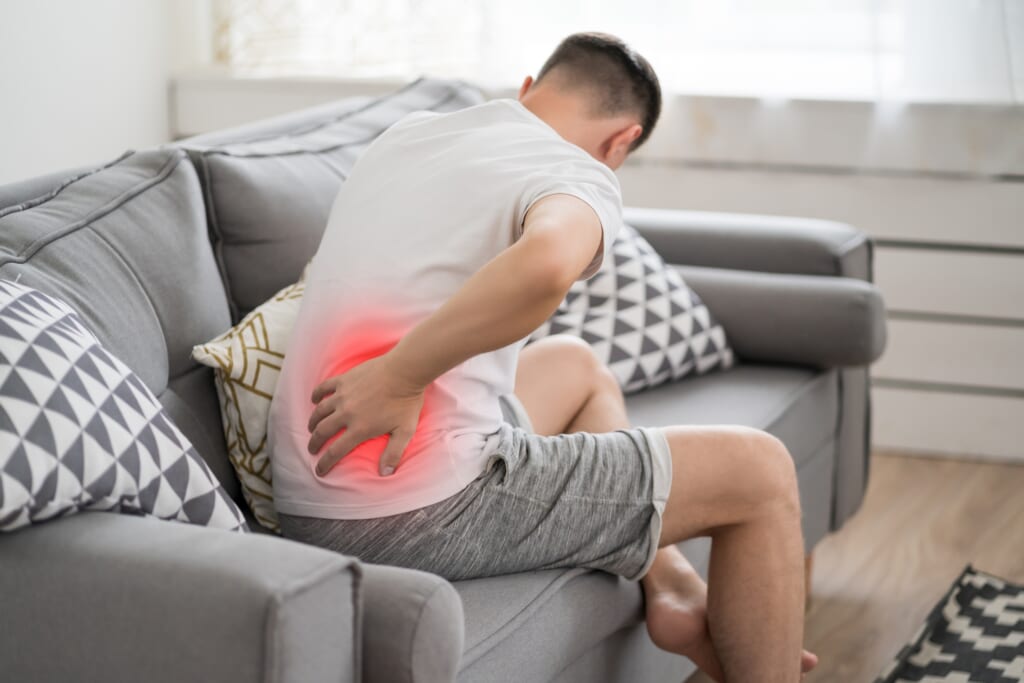
Are you worried that the intense pain in your lower back or buttocks could be a hernia? Lower back and buttock pain is not uncommon among people in their prime working years. This article provides accurate information about hernias and explains treatment options, from conservative treatment to regenerative medicine, in an easy-to-understand manner
table of contents
What is a herniated disc? Mechanism and patient background
A herniated disc occurs when part of the intervertebral disc, which acts as a cushion for the spine, protrudes and puts pressure on the nerves, causing pain and numbness. It can occur suddenly due to trauma such as an accident, or it can be triggered by poor posture
What is a herniated disc?
Intervertebral discs, made up of annulus fibrosus and nucleus pulposus, connect the vertebrae of the spine and act as cushions. A herniated disc occurs when part of the disc protrudes and compresses the nerves, causing symptoms such as pain and numbness. It can occur suddenly due to trauma such as an accident or repeated minor injuries, or it can easily occur when lifting heavy objects in an awkward position
Background of patients with herniated disc
The male-to-female ratio is approximately 2-3:1, with herniation occurring more frequently in men. The most common age group is between the 20s and 40s. It is thought that the most common in this age group [mf1.1] is when the membrane covering the intervertebral disc is weakened, resulting in strong pressure, which can easily extrude the contents through weak or torn parts of the membrane. Over 80% of cases occur in the lower lumbar spine (between the L4/L5 and L5/S1 vertebrae). However, after the age of 50 [mf2.1], the contents of the intervertebral disc harden, making herniation less likely to occur
Factors that contribute to disc herniation [mf3.1]
There are various possible causes for the onset of the disease, but it is not clear whether environmental factors or sports are factors
environmental factors
While there are reports that the incidence rate is higher in heavy laborers, professional drivers, and metal and machinery workers, studies comparing them with control groups have shown the opposite result, so no clear conclusion has been reached.In addition, studies comparing them with control groups have not found any clear associations with sports such as baseball, golf, tennis, soccer, wrestling, and swimming
Genetic factors
On the other hand, it is known that juvenile-onset herniated discs show a high degree of familial clustering, with the same tendency being seen from parent to child or between siblings
References:Japanese Orthopaedic Association | Orthopedic Series 2 "Lumbar Disc Herniation"
References:Japanese Society for Clinical Orthopaedic Surgery | Lumbar Disc Herniation
References:Japanese Orthopaedic Association | Lumbar Disc Herniation Treatment Guidelines
Herniated discs are dangerous symptoms that should not be overlooked
Common symptoms of a herniated disc include:
- Pain in the lower back or buttocks
- Numbness or pain radiating to the legs
- Difficulty putting strength into your legs
- Difficulty moving
The pain worsens when carrying heavy objects or moving, and the spine may curve sideways to avoid the pain (scoliosis). Particular care is required when there is significant damage to the nerves. Severe compression of the nerve roots can lead to paralysis of the legs. Furthermore, if the cauda equina, a bundle of nerves located below the spinal cord, is affected, there is a risk of loss of bladder and bowel control, leading to incontinence. If you experience any of these urinary problems, you should see a doctor immediately
Reference:Japanese Society for Clinical Orthopedic Surgery | Lumbar Disc Herniation
Conservative treatment for herniated disc
Unless the nerve loss symptoms are progressive or severe, the basis of treatment is conservative therapy. When the pain is severe, patients are encouraged to rest and pain is controlled by taking anti-inflammatory analgesics, vitamins, and muscle relaxants, as well as epidural blocks, nerve root blocks, and the use of corsets. Once the pain subsides, exercise therapy, such as traction therapy and abdominal muscle training, is performed. Strenuous exercise is restricted, but walking and light activity are permitted within acceptable limits
References:Keio University Hospital | Understanding the Disease "Lumbar Disc Herniation"
;MSD Manual | Lumbar Disc Herniation
;Japanese Orthopaedic Association | Orthopedic Series 2 "Lumbar Disc Herniation"
When surgery is necessary and regenerative medicine is an option
Even if you are diagnosed with a herniated disc, there are only a limited number of cases where immediate surgery is required. If there are no serious symptoms, options other than surgery can be considered. In recent years, regenerative medicine, which promotes tissue repair without surgery, has been attracting attention as a new option
When surgery is necessary
A hernia does not necessarily mean immediate surgery. Immediate surgery is required in cases where there is difficulty urinating or defecating (cauda equina syndrome) or where paralysis of the lower limbs (muscle weakness) is rapidly progressing. Surgery is also considered when pain does not improve after three months of conservative treatment and interferes with daily life. In other cases, there is room to consider non-surgical methods. It is important to note that even if the protruding part is removed surgically, the degeneration (aging) of the intervertebral disc itself is not cured, so there is a possibility of recurrence in the same or another location
Application of regenerative medicine to herniated discs [mf4.1]
In recent years, regenerative medicine has been researched as a new treatment option. One treatment method involves concentrating platelets taken from the patient's own blood and administering them to the affected intervertebral disc. In addition, in stem cell therapy, the relationship between cytokines (repair substances) released by stem cells and nerve inflammation is being studied
However, these treatments are not yet established as standard medical care, and many aspects of their indications and effectiveness are still under research. This is an area where further research is eagerly awaited
summary
Although the mechanism behind the development of herniated discs remains unclear, immediate surgery is not always necessary even when diagnosed. In many cases, conservative treatment is attempted, and surgery is considered if there is no improvement. The age at which herniated discs most commonly occur coincides with the busy generation with responsibilities at work and at home. Many people continue to work despite pain, or are too busy to seek treatment. For those who wish to avoid surgery or hospitalization, regenerative medicine holds new possibilities for improving symptoms