
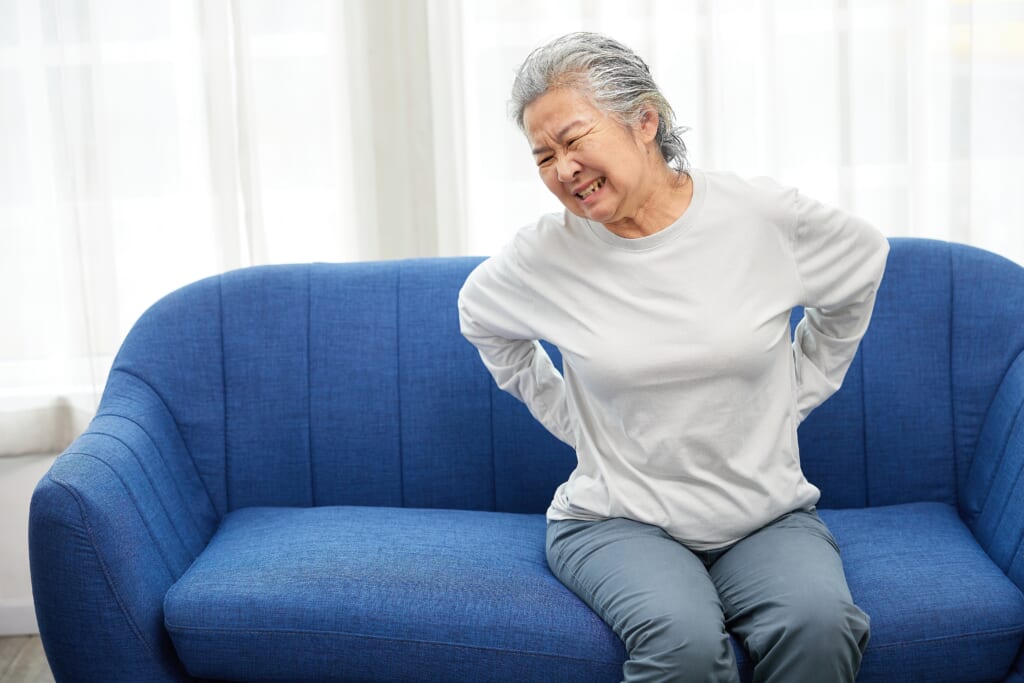
"My legs hurt after walking a little, but they go away when I rest." These symptoms may be a sign of spinal stenosis. This condition causes not only lower back pain, but also numbness in the legs and difficulty walking, and if left untreated, it can significantly reduce your quality of life
This article clearly explains the mechanisms behind spinal stenosis, self-care at home to prevent it from worsening, and the options for understanding and managing your current pain
table of contents
What is spinal stenosis?
Spinal stenosis is a condition in which the nerve passages in the spinal cord narrow, putting pressure on the nerves and causing numbness and pain. A typical symptom is the inability to walk long distances continuously
Mechanism of spinal stenosis
The passageway through which spinal nerves pass, surrounded by the spine, intervertebral discs, joints, ligaments, etc., is called the spinal canal, and spinal stenosis occurs when the spinal canal narrows with age. Spinal stenosis occurs when nerves are compressed and blood flow to the nerves is reduced due to spinal deformation, bulging intervertebral discs, or thickening of ligaments caused by aging. Generally, it is more likely to occur in middle-aged and elderly people than herniated discs
Symptoms of spinal stenosis
A typical symptom is the inability to walk long distances continuously. This is called intermittent claudication, and the most distinctive symptom is the alternating cycle of walking and resting. Numbness and pain appear in the thighs and below the knees, but surprisingly, in many cases the lower back pain itself is not very severe
There are almost no symptoms when you are resting, but the typical pattern is pain and numbness when standing or walking. As the disease progresses, you may experience weakness in the lower limbs, hot flashes around the anus, difficulty urinating, and urinary problems such as urinary leakage, so caution is required
Reference:Japanese Orthopaedic Association | Orthopedic Series 8 "Lumbar Spinal Stenosis"
Self-care at home to prevent the condition from worsening!
There are self-care measures you can take at home to prevent spinal stenosis from getting worse
Postures that should not be done (arching the waist) and recommended postures (bending forward)
When you have spinal stenosis, there are postures that you should avoid and postures that are recommended
Postures to avoid: Arching your back
If you bend your lower back backward, the inner diameter of the spinal canal will become even narrower, increasing pressure on the nerves and making the symptoms more likely to worsen. In your daily life, you should be careful about the following movements:
- Reaching for high places: Hanging out laundry, grabbing luggage from a shelf, etc
- Reading or using a smartphone while lying face down
- Sleeping on a mattress that is too soft: Your lower back will sink in, causing your lower back to arch
- Long periods of standing work: Standing upright for long periods of time can cause your lower back to arch, so you need to find ways to tilt your pelvis, such as by placing one foot on a platform
It's a movement that we tend to do unconsciously, but simply being conscious of avoiding it on a daily basis can reduce strain on the nerves and help prevent pain
Recommended posture: leaning forward
Conversely, bending forward stretches the posterior parts of the spine (such as the ligamentum flavum) and widens the spinal canal, relieving pressure on the nerves. Examples of comfortable postures include:
- Bicycles: Holding the handlebars naturally causes you to lean forward, making it easier to move around than walking
- Cart pushing: If you can walk for long periods of time while pushing a supermarket cart, this could be a clue to the diagnosis of spinal stenosis
- When sleeping: It is recommended to lie on your side and curl your back slightly, hugging your knees
There are many cases where people find it difficult to walk but cycling is fine, so it is important to incorporate these postures into your daily life and prevent a lack of exercise
Stretching techniques to relieve pain
For spinal stenosis, stretching is effective in widening the spinal canal and eliminating arching of the lower back
- Knee hugging exercise (gas release pose): Lie on your back, hug both knees with both hands, and slowly pull them towards your chest
- Cat and Cow (hands-on-hand exercise): Get on all fours, exhale, and arch your back, peeking into your belly button
- Stretching the iliopsoas muscle (front of the hip joint): If the front of the hip joint is stiff, it is easy to arch your lower back, so step forward with one foot and assume a position similar to stretching your Achilles tendon, stretching the base of your back leg
However, if the pain or numbness becomes severe, do not force it, but stretch slowly within a range that feels comfortable
Points to note in daily life
It is important not to let your body get cold. This is because poor blood flow makes you hypersensitive, which can lead to increased numbness and pain. Also, don't walk until you feel pain. Instead, walk a little and then sit down and take a break (bend forward) frequently, which will help you increase the total distance you travel
Treatment methods and limitations for spinal stenosis
At present, there is no clear answer as to whether conservative treatment is more effective than doing nothing (letting the condition progress naturally). However, it is common to start with treatment that puts less strain on the body
Conservative treatment methods
In addition to rehabilitation and the use of a corset, drug therapy is also implemented. Vasodilators (prostaglandin E1 preparations) are used to improve blood circulation to the nerves of the spinal cord. If the pain is severe, nerve block injections, which temporarily block pain transmission and suppress inflammation, are also an option as a conservative treatment method
Surgery (decompression/fixation)
If walking difficulties progress and interfere with daily life, surgery to relieve the pressure on the nerve may be considered. However, surgery has its limitations. It is important to note that even if the physical pressure is removed through surgery, there are cases where the damage to the nerve itself that has been compressed for a long period of time does not recover, and only numbness remains
References:Japanese Orthopaedic Association | Guidelines for the Treatment of Lumbar Spinal Stenosis
;Japanese Orthopaedic Association | Orthopedic Series 8 "Lumbar Spinal Stenosis"
Research on regenerative medicine related to nerve inflammation and damage
In recent years, research into regenerative medicine has been progressing as a new approach to treating spinal stenosis. In regenerative medicine, therapies using the patient's own cells, such as adipose-derived mesenchymal stem cells and the supernatant (cytokines) obtained during their culture process, are being studied
While the relationship between these conditions and the state of nerves and surrounding tissues is being investigated in basic and clinical research, they are not yet established as alternative treatments to surgery
Furthermore, in clinical trials conducted at university hospitals and other institutions, there are cases where it is being considered in combination with surgery, and further research is needed to determine its role as a treatment
Therefore, at this time, it is considered important to focus on standard treatments (conservative therapy and surgery)
References:Japanese Orthopaedic Association | Guidelines for the Treatment of Lumbar Spinal Stenosis
;Hokkaido University Hospital | Initiation of Physician-Initiated Clinical Trial of Regenerative Medicine Using Mesenchymal Stem Cells and Biomaterials for Patients Who Underwent Lumbar Spinal Stenosis Surgery
summary
Don't give up and think "it's just because I'm getting older"; taking early action will help protect your ability to walk in the future. First, it's important to adopt a perspective of managing your symptoms through self-care and conservative treatment. If your condition doesn't improve, it's important to consult with a specialist doctor and consider the treatment options currently available. To be able to walk on your own two feet for as long as possible, consult with a specialist doctor
HELENE Clinic Instagram is here
Supervisor: Yuzo Terakawa (neurosurgeon)