
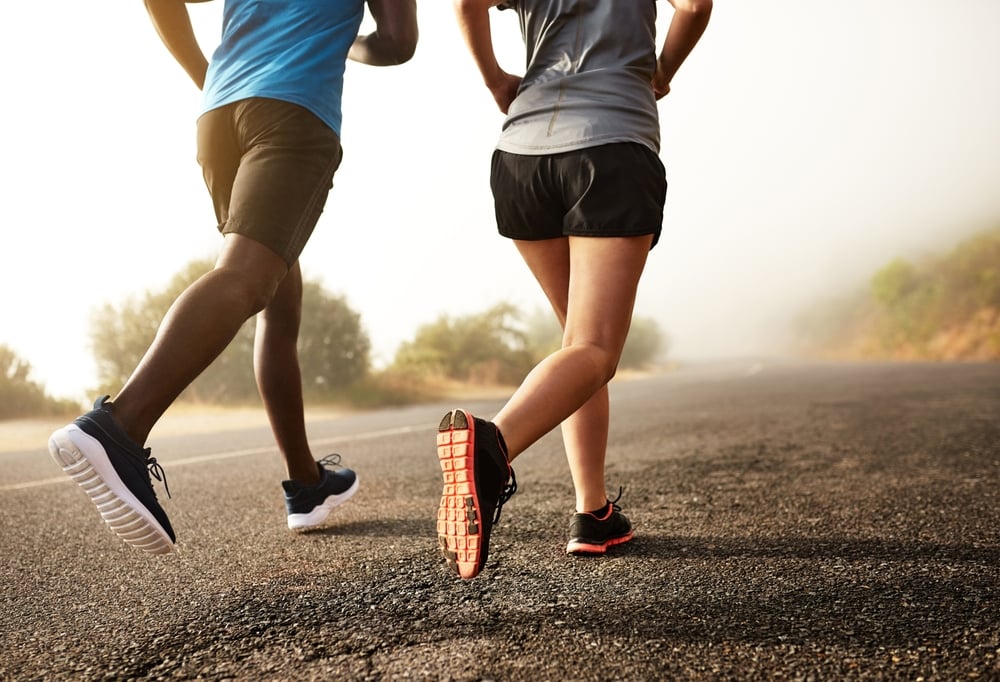
Running is a popular aerobic exercise that is easy to start because it does not require any special equipment
However, naturally, many people are concerned about the strain on their knees due to the repeated impact they receive when landing.Knees are also a place where deformation is likely to occur, so it's natural to think, "Maybe continuing to run is worse for my knees than I thought."
This page provides an easy-to-understand explanation of the relationship between running and knee osteoarthritis. Please refer to this page if you want to continue running in a healthy way while reducing the risk of knee osteoarthritis
table of contents
Running is a stressful exercise for the knees
In conclusion, running is an exercise that puts a certain amount of strain on the knees
It is said that the impact on the knees when landing is 3 to 4 times the body weight. Since this action is repeated many times, it will put a certain amount of strain on the knees
Does running cause osteoarthritis of the knee?
Now, let's get to the main question: "Can running cause osteoarthritis of the knee?" The general consensus is that it cannot be a direct cause
Furthermore, the onset of knee osteoarthritis is intertwined with many factors. Because there are a wide range of factors that increase the risk of developing the disease, such as age, degree of obesity, muscle weakness, and occupational characteristics, it is difficult to specifically study the effects of running alone
The benefits of running for your knees
If you pay attention to your form and manage your weight properly while running, it won't be a problem. In fact, it's said that putting the right amount of stress on your knees can actually make them stronger
This is because it stimulates cartilage cells and promotes the production of a substance called proteoglycan. Proteoglycan plays a role in increasing the elasticity and durability of cartilage, so this shows that receiving impact when your foot hits the ground is not necessarily bad for your knees, and that a moderate impact can actually be beneficial to your knees
The movement of the joints during running also increases the circulation of joint fluid, which has the benefit of improving the supply of nutrients to the cartilage and facilitating the removal of waste products. Running itself also has the effect of strengthening the muscles around the knee, such as the quadriceps and hamstrings, which has many benefits that can protect the knee in the long term
Running in the wrong condition can cause knee pain
For example, if you run for a long time while overweight, it puts more strain on your knees. It can cause the cartilage to wear down or become degenerated and stiff. Running with incorrect form or wearing ill-fitting shoes can also increase the strain on your knees more than necessary
In order to continue running safely, it is important to use every possible method to bring the stress on your knees to an "appropriate state."
Things to note when running
With the above in mind, let's take a look at some specific ways to reduce the strain on your knees when running
weight control
When running, the load on your knees is 3 to 4 times your body weight, so it's easy to imagine that as your weight increases, the strain on your knees will naturally increase
Furthermore, if the muscles around the knee are weak, the knee will be subjected to even greater repeated strain
Also, if you have started running to lose weight, it is important to understand that in the early stages, when you have not yet lost weight, your knees are more likely to be strained
In that case, it is recommended to start by shortening the distance or incorporating interval running, which involves alternating between running and walking
Weight control does not mean you will lose weight immediately, so you should also consider using running gear such as highly shock-absorbing shoes and knee supports, which will be introduced later
Run with proper form
What do you need to pay attention to when trying to run with the "correct form"?
Keep your spine straight (avoid leaning forward too much)
Keeping your pelvis upright and your spine straight, with a slight forward lean, is said to increase forward propulsion and reduce the risk of injury
However, leaning too far forward puts strain on your knees and hips, and also makes it difficult to perform the forefoot running technique, which will be introduced later
To begin with, if you run in a forward-leaning position, your chest will be compressed, restricting lung expansion and making it difficult to breathe. As a result, your form will gradually deteriorate, putting strain not only on your knees but also on various other parts of your body. Make sure to run with your pelvis upright and your back straight. If you make a conscious effort to look a little into the distance, your back will naturally straighten
Land on your forefoot (slightly forward, towards your toes)
When landing on your heel, putting strain on your knees. For this reason, it is best to land slightly forward of your foot. This is called the forefoot running style. Since the center of gravity differs from person to person, be sure to keep your pelvis upright and your back straight as mentioned above when running, and you will naturally land forward of your foot
If you find it difficult to perform forefoot running even when you keep your back straight, it may be because your pelvis is not properly raised and your center of gravity is leaning backward. If you try to perform forefoot running in this state, you risk injuring your Achilles tendon, so try to use other methods to reduce the strain on your knees
Increase your cadence (number of times you land)
Cadence is the number of times your foot strikes the ground per minute
Although it depends on your running speed, it is said that the number of steps that put a minimum strain on your knees and hips is 170 to 180 per minute (that is, 85 to 90 per minute on each side)
When running naturally, most runners' cadences fall between 150 and 200
The shorter you are, the more frequently you will land on the ground, but taller people will take larger steps, so your cadence will tend to be slower even if you run the same distance. However, remember that the more frequently you land on the ground, the more the strain on your knees will be distributed
If you suddenly increase your cadence, your form may deteriorate, or you may become so concerned with your step width that you lose the enjoyment of running. It's best to gradually increase your cadence over a period of about a month
Use shoes that suit you
When it comes to reducing the strain on your knees, it's also essential to have running shoes that fit you well
Sufficient shock absorption
Shoes with cushioning that absorbs shock will reduce strain on your knees
Arch support
The size of the arch of the foot also varies from person to person
It is a good idea to check whether you have a high arch (large arch), normal arch, or low arch (small arch, flat feet) and choose shoes that have support for your respective arches
The arch of the foot is essentially there to absorb shock. If you wear shoes that don't fit your arch type, the spring function of your foot won't work properly and you won't be able to absorb shock, which will put strain on your knee, so you need to be careful. However, it can be difficult to tell on your own, so one option is to have your arch type checked at a specialist store
Use sports insoles
Using sports insoles and other products can also support the arch of your foot, helping to reduce fatigue while running, improve performance, and prevent injuries
Strengthen your legs
If the muscles around the knee are weak, you are more likely to injure your knee
Try the following methods to easily strengthen your knees at home
Quadriceps training
Lie on your back and place a plastic bottle or towel under your knees, then press them down onto the floor
Gastrocnemius and soleus muscle training
Stand upright and hold onto a support, then lift your heels and stand on your toes
Abductor muscle training
Lie on your side and lift your top leg out to the side
Adductor muscle training
Lie on your back with your knees bent and place the ball between your knees and crush it
Use of supporters
In most cases, muscle strength does not increase immediately, not just around the knee, even with muscle training. To compensate for muscle weakness, you may want to consider using a knee support. There are a wide variety of types available, from those that have a strong effect of increasing stability to those that guide the knee joint in the correct direction
summary
We have focused on the relationship between running and osteoarthritis of the knee and explained how to run while reducing the strain on your knees
It is important to carefully observe your physical condition and the condition of your knees, and if you have knee pain or concerns, consult a specialist. Try to reduce the strain on your knees by using sports equipment, etc., so that you can continue to enjoy your life as a runner for a long time
In addition, regenerative medicine using stem cells and other treatment methods has been proven effective in the field of knee joint treatment .
Research and clinical trials are still ongoing, but regenerative medicine such as stem cells is still used as a treatment method. In the future, it will be developed as a more familiar treatment. We hope that you will take this opportunity to develop an interest in regenerative medicine, acquire knowledge about it, and actually consider treatment.
Knee pain and neuralgia do not go away easily. She has been suffering from illness and beauty for many years. Please feel free to contact us if you have any concerns regarding your daily life.
Omotesando Helene Clinic specializes in regenerative medicine that does not place a burden on the body, and provides pre-counseling for those who cannot immediately start treatment.
"I'm concerned, but I can't decide if prevention is really necessary now." "I haven't decided whether to get treatment, but I'd like to hear more about it first." There's no problem in cases like these. You may be unaware that you're at risk of losing your life, so please feel free to contact us.
・Inquiry form (LINE, WeChat, email): https://stemcells.jp/contact/
[Regenerative Medicine Outpatient] 03-3400-2277
Supervision: Dr. Yasushi Tsuda