
Stem Cell Research and Therapy (IF: 8.0) | June 2024 | Jafarzadeh A et al.
table of contents
Abstract (Japanese translation of the original paper's summary)
the purpose
To systematically review randomized controlled trials (RCTs) of skin disease treatments using various regenerative medicine methods (platelet-rich plasma, adipose vascular cells, cell therapy, culture supernatant, etc.)
method
A search for randomized controlled trials (RCTs) was conducted in PubMed, Scopus, and Web of Science, covering literature up to January 2024. Key data extracted included participant characteristics, sample size, treatment type, efficacy, and adverse events
result
This study analyzed 64 studies involving 2,888 participants (44.8% female, 55.2% male, mean age 27.64 years). The most common conditions treated were male pattern baldness (AGA) at 45.3% and tinea versicolor at 31.2%. The most frequently used procedures were platelet-rich plasma (PRP) and autologous epidermal melanocyte/keratinocyte cell transplantation. Improvement rates of up to 68.4% were reported for AGA and up to 71% for tinea versicolor. Effectiveness was also observed in all cases of other conditions (alopecia areata, tinea versicolor, lichen planus, bullous pemphigoid, etc.)
conclusion
Regenerative medicine is an effective treatment option for certain skin diseases. Further clinical trials are recommended to verify its effectiveness
Main results
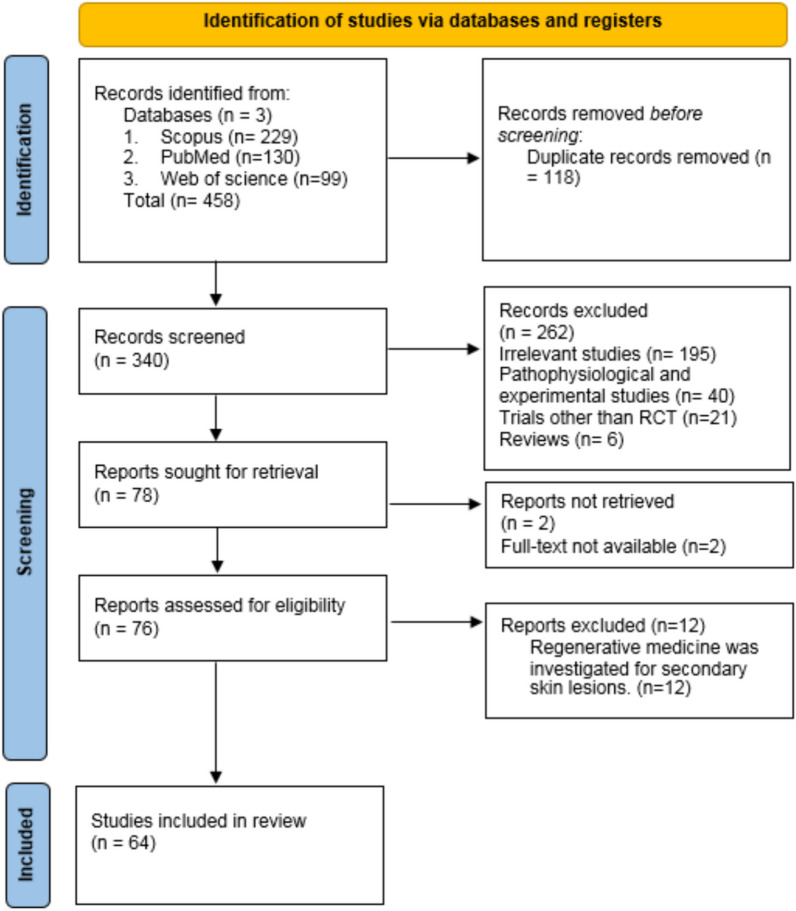
PRISMA Search Flow
"PRISMA
Fig. 1. PRISMA chart of studied articles"
Breakdown of target diseases
- Male pattern baldness (AGA): 45.3% (most common)
- Vitiligo vulgaris: 31.2%
- Others: alopecia areata, tinea versicolor, atheroma acnes, lichen planus labialis, chronic telogen effluvium, erosive oral lichen planus, malnutrition epidermal dysplasia
Effectiveness
| Indications | Studies that confirmed effectiveness | improvement rate |
|---|---|---|
| AGA | 86.2% | Maximum 68.4% |
| vitiligo vulgaris | 100% | up to 71% |
| Alopecia areata | 83.3% | valid |
| powdery acne | 100% | valid |
| LSA | 50% | Partially effective |
| chronic telogen effluvium | 100% | valid |
Treatment methods used (main procedures)
- PRP (platelet-rich plasma) injection: Most frequently used in AGA treatment. Hair follicle transplantation under PRP preservation is also performed
- Autologous epidermal melanocyte/keratinocyte cell transplantation: Most frequently seen in tinea versicolor. Including isolated melanocyte transplantation and hair follicle-derived source cell transplantation
- MSC (Mesenchymal Stem Cell) Intravenous Infusion: Used as a systemic therapy for a wide range of skin diseases
- SVF (Aspiration Fat): A group of cells containing adipose-derived stem cells and individual growth factors
- Conditioned Media: Only humoral factors from the stem cell culture medium are injected
- bFGF + PRP combination: Synergistic effect of growth factors and platelet sources
Conclusions and Clinical Implications
Regenerative medicine technology has been confirmed to be an effective treatment option for all targeted skin diseases. However, intervention protocols (injection interval, concentration, dosage, and route of administration) varied significantly between studies, and the development of standardized treatment guidelines is a future challenge