https://www.mdpi.com/2673-8937/6/2/15
Matsuoka, T.; Kobayashi, N. Cardiovascular Event Surveillance Following High-Dose Intravenous Mesenchymal Stem Cell Therapy: A Single-Center Real-World Observational Study. Int. J. Transl. Med. 2026 , 6 , 15. https://doi.org/10.3390/ijtm6020015
This study retrospectively tracked MACCE (the incidence of life-threatening illnesses such as myocardial infarction and stroke) in three groups: the general Asian population (green dotted line), a group administered 100 million stem cells (yellow line), and a group administered 1 billion stem cells (blue line) over a 10-year follow-up period.
The vertical axis of the graph represents the MACCE-free rate, i.e., the rate of not developing a major illness, and the horizontal axis represents the number of years elapsed.
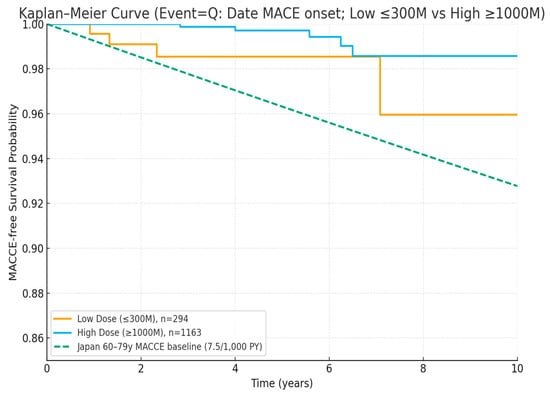
As the years go by, each line slopes downwards to the right, but it can be seen that after 10 years, the incidence of serious illness is significantly lower when 1 billion doses are administered compared to when 100 million doses are administered
Our hospital's distinguishing feature has been the high level of our technical expertise demonstrated by the large number of cells we use . This paper clearly shows that a high dose of stem cells leads to a lower incidence of serious illness in the long term and promotes longevity
The difficulty with stem cells is that they affect various sites, making it challenging to establish scientific evidence of their clinical effectiveness. Frankly, it's easier to establish therapeutic effects for specific diseases like "XX disease."
However, global research is shifting towards aging research, and I believe the forefront of this field will be the "longevity effects of stem cells." I hope this paper will contribute, even in a small way, to the scientific verification of these findings